Less Is More Power: How Boxing Yourself In Sets Your Creativity Free
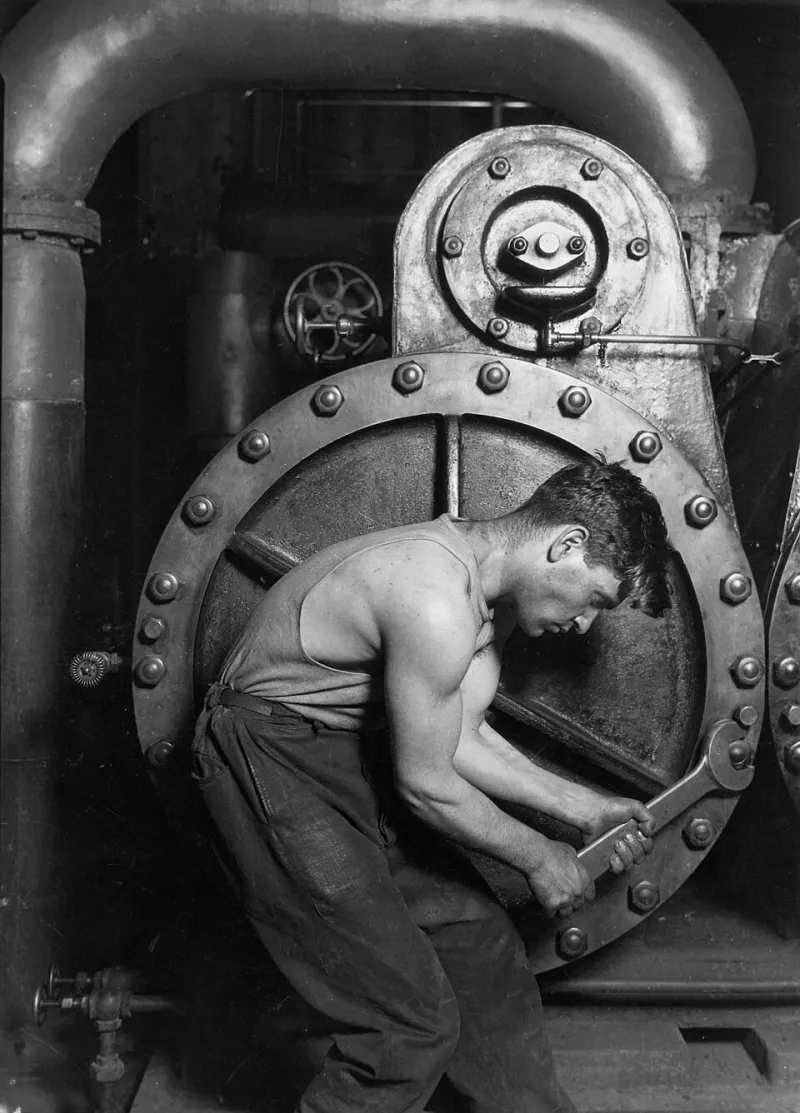
Photo: Lewis Hine, Public domain, via Wikimedia Commons
There's a story every art school professor loves to tell: give a student a blank canvas and infinite time, and they'll stare at it for weeks. Hand that same student a napkin and a Sharpie with twenty minutes on the clock, and they'll produce something genuinely surprising. The paradox isn't a fluke. It's actually baked into how creative thinking works.
We tend to treat limitations — tight budgets, short deadlines, a stripped-down toolkit — as problems to overcome. But a growing body of evidence from psychology, and frankly just decades of creative history, suggests we've been reading the situation completely wrong. Constraints don't block innovation. In a lot of cases, they cause it.
The Brain Likes a Fence
Here's the psychology in plain terms. When you have unlimited options, your brain has to spend enormous energy just managing the possibility space. Decision fatigue kicks in early. You start second-guessing. You optimize instead of invent.
But when the walls close in — when you can't do the obvious thing because you don't have the budget, the equipment, or the time — your brain is forced to route around the obstacle. Psychologists call this "productive constraint." The limitation acts like a channel, directing cognitive energy toward novel combinations instead of familiar defaults.
Patricia Stokes, a researcher who spent years studying creativity in artists from Monet to Picasso, found that the painters who produced their most original work were almost always operating under some form of self-imposed or circumstantial restriction. The constraint wasn't incidental to the breakthrough. It was the mechanism.
What the Film World Figured Out First
Low-budget cinema is basically a masterclass in constraint-driven creativity. When Kevin Smith shot Clerks in 1994 for roughly $27,000 — using a convenience store he actually worked at, shooting only at night, and casting his friends — the limitations didn't water down the film. They defined its aesthetic. The black-and-white photography, the static shots, the dialogue-heavy scenes: all of it emerged from necessity and became the movie's signature.
The same logic runs through the entire New Hollywood movement. Directors like John Cassavetes were making films with skeleton crews and no studio safety net, and the rawness that came out of those conditions is exactly what made the work feel alive. Compare that to the bloated mid-budget films that studios greenlit with "enough" money — plenty of them disappeared without a trace.
Constraint forced invention. Abundance just bought comfort.
Three Chords and the Truth
Music tells the same story from a different angle. Punk rock in the late '70s was, at its core, a constraint movement. You didn't need to be a virtuoso. You didn't need a major label deal or a 24-track studio. The whole ethos was: pick up whatever's available and make noise with it now.
The Ramones built an entire career on fast tempos, short songs, and deliberately simple chord structures. That wasn't laziness — it was a framework. And within that framework, they created a sound distinct enough to reshape popular music for the next forty years.
Jack White has talked openly about how he designs constraints into his recording process on purpose — using older, temperamental equipment, limiting the number of takes, sometimes working with instruments that are slightly broken. He's not being nostalgic. He's being strategic. The friction forces him to make decisions he wouldn't otherwise make, and those decisions are where the interesting stuff lives.
Visual Art and the Power of the Arbitrary Rule
In visual art, the constraint tradition runs even deeper. The Oulipo movement in France — a loose group of writers and artists that included Georges Perec — made constraint-based creation into a full philosophy. Perec wrote an entire novel, La Disparition, without using the letter "e." Not as a stunt, but as a way of forcing language into configurations it would never find on its own.
On the visual side, think about what happens when painters commit to a limited palette. James Abbott McNeill Whistler's near-monochromatic nocturnes weren't just a stylistic preference — they were a structural decision that forced him to find emotional range within a narrow tonal band. The limitation became the language.
Even in commercial design, the most iconic work often came out of tight briefs. The original Apple logo, the Nike swoosh, the FedEx arrow hiding in plain sight — none of these came from "do whatever you want." They came from specific, sometimes brutal constraints around what the mark needed to communicate and where it needed to work.
How to Build Your Own Box
So how do you actually use this in your own practice? The key is that constraints work best when they're specific and chosen deliberately — not just random suffering.
Pick one tool and stick with it. If you're a digital illustrator, try completing an entire project using only three brushes. If you're a photographer, shoot a full series on a single prime lens. The limitation forces you to develop fluency instead of just switching tools whenever something gets hard.
Set a time limit that's slightly too short. Not so short that the work is sloppy, but tight enough that you can't afford to overthink. Parkinson's Law — the idea that work expands to fill the time available — is real. Compress the window and the work often gets sharper.
Constrain your color, your palette, your vocabulary. Pick three colors for a design project. Write a piece using only simple sentences. Limit your musical arrangement to four instruments. The narrower the lane, the more creative your driving has to get.
Create a constraint that directly conflicts with your default habit. If you always start with sketches, start with words. If you always work alone, build something with a collaborator who has a completely different background. The point is to interrupt the autopilot.
The Real Advantage
Here's the thing nobody talks about enough: constraints don't just produce more original work. They also make the work more yours. When you solve a problem under pressure with limited tools, the solution carries your fingerprints in a way that an unconstrained, resource-rich project often doesn't. The workaround becomes the signature.
That's ultimately what creative identity is built from — not the moments when everything was easy and available, but the moments when you had to figure something out. The friction is the feature.
So the next time you're frustrated by what you don't have — the budget that didn't come through, the software you can't afford, the timeline that's too tight — consider the possibility that you've just been handed an advantage. The box isn't a prison. It's a prompt.
Start building.