Nobody Creates in a Vacuum: The Case for Learning by Copying

Photo by Photo by Alireza Banijani on Unsplash on Unsplash
There's a story most creatives tell themselves early on: that somewhere out there, buried beneath enough journaling and solitary walks, is a totally original style waiting to be discovered. Just you, a blank canvas, and pure inspiration. No influences, no borrowing — just authentic vision, fully formed.
It's a beautiful story. It's also mostly fiction.
The artists, designers, and makers who've built genuinely recognizable bodies of work didn't stumble into their aesthetic in a vacuum. They studied obsessively. They copied deliberately. They dissected the techniques of people they admired until those techniques became muscle memory — and then something personal started to emerge from the wreckage.
This isn't a hot take. It's basically how mastery works. But there's still a lot of hand-wringing in creative circles about influence versus imitation, originality versus theft. So let's actually dig into this.
The Picasso Problem (And Why It's Misunderstood)
Everyone's heard the quote: "Good artists borrow, great artists steal." It gets tossed around constantly, usually to justify some vague notion that creative freedom includes ignoring other people's work entirely. But that's not what it means.
The quote — whether it originated with Picasso, T.S. Eliot, or someone else entirely — is about transformation. Borrowing means you take something and leave it recognizable. Stealing, in this context, means you absorb something so completely that it becomes unrecognizable in the final output. It's yours now. It's been metabolized.
Picasso himself spent years rigorously studying Velázquez, Goya, and Cézanne before Cubism ever happened. His early academic paintings are technically stunning and stylistically conventional. The radical work came after the deep study, not instead of it.
The same pattern shows up everywhere once you start looking.
Influence Is a Feature, Not a Bug
Think about how graphic design developed in the United States throughout the 20th century. The Swiss International Style — all clean grids, Helvetica, negative space — crossed the Atlantic and got absorbed into American commercial design. But it didn't stay Swiss. American designers like Paul Rand took those structural principles and pushed them into something more playful, more culturally specific, more American. The influence is traceable. The result is distinct.
Or look at hip-hop production. Sampling is literally the foundation of the genre. Producers like J Dilla or Pete Rock built entire careers on the art of recontextualizing existing recordings — slowing a break, chopping a melody, layering something unexpected underneath. Nobody calls that plagiarism. We call it craft.
Visual artists, writers, filmmakers — they all do versions of this. The question isn't whether you're influenced. The question is whether you're doing anything interesting with those influences.
The Difference Between Copying and Plagiarism
Okay, but there's a line somewhere, right? Yes. And it's worth being clear about where it sits.
Plagiarism is passing off someone else's specific work as your own — lifting an illustration, copying a design asset, reproducing writing without credit. That's straightforward theft in the legal and ethical sense, and it's not what we're talking about here.
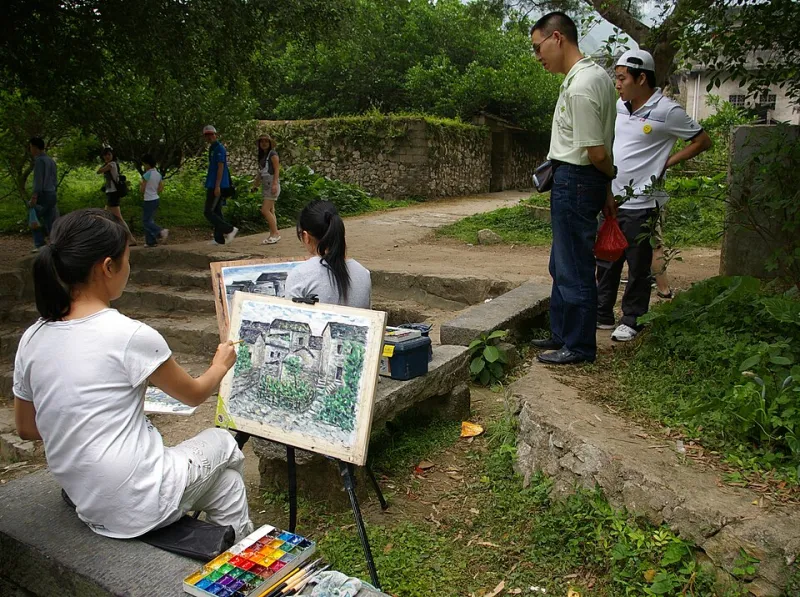
Deliberate imitation as a learning practice is something else entirely. When you sit down and try to recreate a piece by an artist you admire — matching their color palette, their compositional logic, their line weight — you're not producing work to sell or publish. You're doing the equivalent of a musician learning someone else's song to understand how it was built. It's a study, not a product.
The goal is to internalize the logic behind the choices, not to reproduce the choices themselves.
A Framework for Ethical Inspiration-Gathering
If you want to develop your own visual or creative language by studying others, here's a practical approach that keeps the process generative rather than derivative:
Go wide before you go deep. Pull from at least five to ten different sources when you're in research mode. If you're only studying one person, you'll end up sounding like a knockoff. When you're synthesizing ten different influences, something genuinely new tends to emerge.
Identify the why behind what you love. Don't just screenshot things that look cool. Ask yourself what specifically is working. Is it the contrast ratio? The unexpected scale relationship? The typeface choice? The more precisely you can articulate what you're responding to, the more deliberately you can apply it.
Recreate before you remix. Try to actually reproduce a piece you admire — not for public consumption, just for yourself. This exercise forces you to slow down and understand decisions you'd normally just absorb passively.
Introduce friction. Once you've studied something closely, change one significant variable. Different color palette, different medium, different subject matter. That constraint forces your own sensibility into the work.
Let time do some of the work. Influences that you absorbed years ago tend to resurface in interesting, transformed ways. Not everything needs to be immediately processed and applied.
Your Style Is a Collage
Here's the reframe that might actually be useful: stop thinking about your creative style as something you find and start thinking about it as something you build. It's a collage of everything you've studied, experienced, and deliberately practiced. Some of those pieces are visible. Most of them aren't.
The designers and artists who have the most distinctive voices aren't people who avoided influence — they're people who had wide influence and processed it deeply. They can usually trace the lineage themselves if you ask them. They're not embarrassed by it. They think of their influences as collaborators across time.
That's a healthier relationship with creative history than the myth of the lone genius conjuring something from nothing. And honestly, it's a more accurate one.
So the next time you find yourself deep in someone else's portfolio, studying how they handle light or composition or negative space — don't feel guilty about it. You're not copying. You're building. There's a difference, and it matters.
Just make sure you actually do something with what you find.